AI Workloads Push Legacy Networks Past Their Limits, Tata Communications Says
AI workloads are straining legacy networks, as Tata Communications promotes sub-10ms latency, dynamic capacity, SASE security and automated resilience.
Summary
Reported facts and sourced claims: A sponsored VentureBeat article presented by Tata Communications argues that continuous AI inference, autonomous-agent communication and real-time data pipelines are creating volatile, persistent traffic that conventional networks were not designed to handle. Published on August 5, 2026, the article cites a Cisco study in which 80% of executives said their companies’ competitive survival would depend on agentic AI. It also cites a Tata-commissioned Bloomberg study finding that three-quarters of leaders view AI as a board-level priority, even though 65% of enterprises remain on transitional or legacy infrastructure. The article does not provide the studies’ sample sizes or methodologies, limiting independent assessment of those figures.
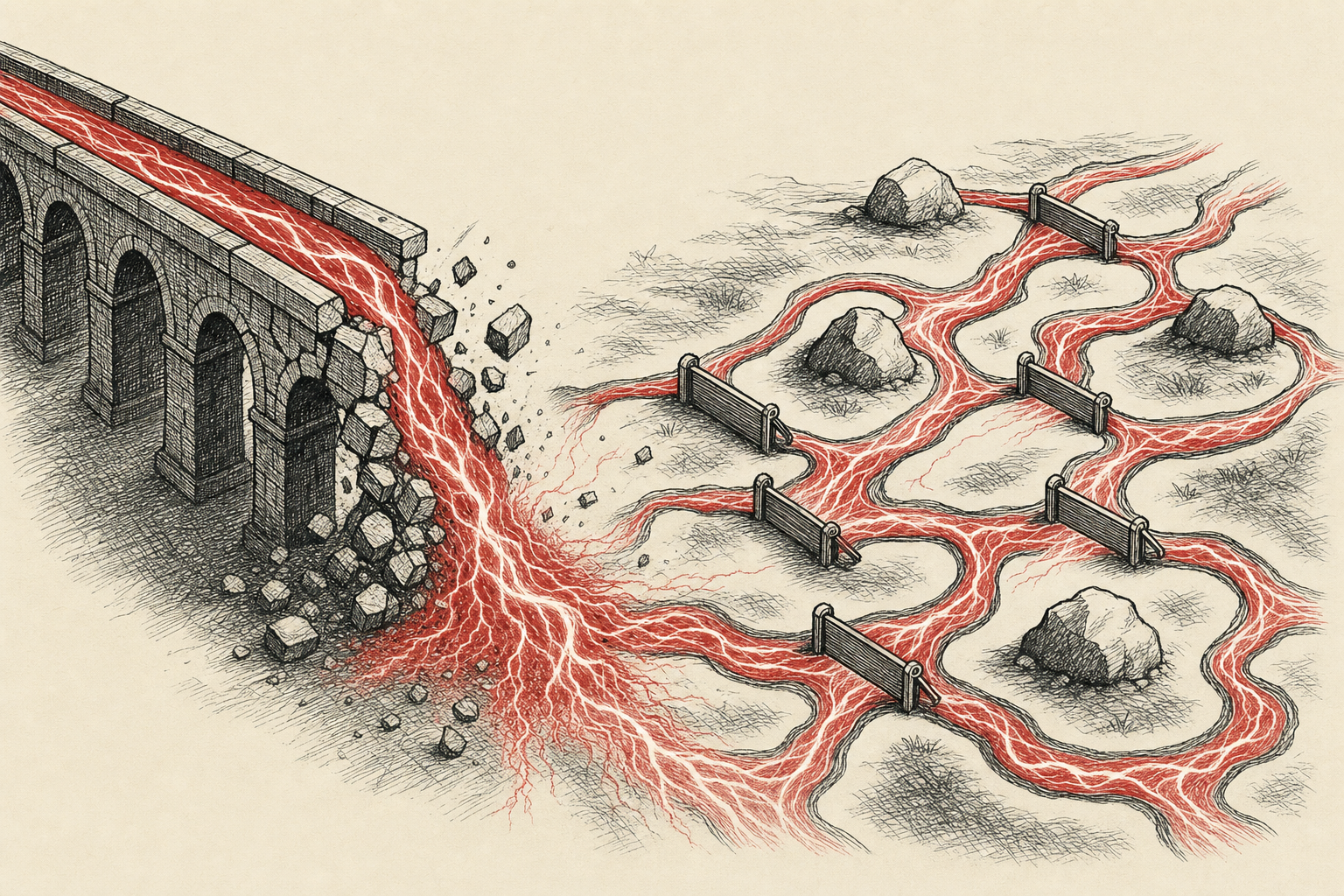
The central technical issue is latency. According to Tata Communications, traditional business software could function with delays of 100 to 500 milliseconds, whereas mission-critical AI applications may require latency below 10 milliseconds. Fraud detection, supply-chain optimization and other systems dependent on live information can lose operational or financial value when congestion delays their data. The article also warns that public-internet performance observed within one country may not continue when traffic crosses borders or connects to overseas cloud platforms because enterprises lack end-to-end control over those routes.
AI distribution adds further complexity. Models, GPUs, data and applications increasingly operate across public clouds, private infrastructure, edge locations, SaaS platforms and end-user devices. The resulting high-frequency east-west traffic between GPUs can turn connectivity into a bottleneck even when sufficient computing capacity is available. Tata Communications executive Kapil, identified only by one name in the article as vice president of Global Network Services, also says AI-driven malicious bots represent about 37% of online traffic. He argues that enterprises have often responded with disconnected security products, producing inconsistent controls and fragmented visibility. His proposed alternative is secure access service edge, or SASE, which combines cloud-delivered networking and security so policies can be applied across cloud, edge and on-premises systems.
Tata Communications presents software-defined, API-controlled networking as the answer. Its IZO Data Centre Dynamic Connectivity platform reportedly uses deterministic multipath routing to redirect traffic within seconds of a disruption. The company calls this a self-healing network and claims it can reduce operating costs by as much as 30%; the sponsored article does not provide independent performance testing. Tata is also working with Amazon Web Services on an AI-ready Indian network connecting major AWS infrastructure locations in Mumbai, Hyderabad and Chennai. The article additionally points to consumption-based bandwidth, 800G services and automated network functions as ways to handle demand spikes without costly permanent overprovisioning.
Interpretation and outlook: The argument reframes networking from a background utility into a control layer for AI performance, security and spending. CIOs, network operators, cloud customers and businesses deploying real-time AI are the groups most directly affected. Tata recommends starting with an infrastructure assessment and then phasing in AI-ready connectivity, improved data exchange and advanced security rather than replacing everything at once. It cites its recognition as a Leader in Gartner’s Global WAN Services Magic Quadrant for a 13th consecutive year as evidence of execution capability. What remains uncertain is whether Tata’s advertised savings and resilience will be reproduced across different customer environments, how widely workloads truly require sub-10ms service, and whether enterprises will fund network modernization quickly enough to match their AI ambitions.
Positives
- Tata Communications says its IZO Data Centre Dynamic Connectivity platform can reroute traffic automatically within seconds when a disruption occurs.
- The company claims its software-defined networking approach can lower operating costs by up to 30%, although the article provides no independent validation.
- Tata Communications and AWS are developing a high-capacity AI-ready network linking major AWS infrastructure locations in Mumbai, Hyderabad and Chennai.
- SASE architecture could provide more consistent security-policy enforcement across cloud, on-premises and edge environments by combining networking and security controls.
- Tata recommends phased modernization beginning with a network assessment, meaning enterprises may not need to replace their entire infrastructure at once.
Risks & concerns
- The Tata-commissioned Bloomberg study found that 65% of enterprises still use transitional or legacy infrastructure despite three-quarters of leaders treating AI as a board-level priority.
- Mission-critical AI workloads may need latency below 10 milliseconds, far less than the 100-to-500-millisecond range tolerated by traditional business applications.
- Kapil estimates that AI-driven malicious bots account for roughly 37% of online traffic, making automated threats harder to distinguish from legitimate activity.
- Enterprises using the public internet for international connectivity may lose end-to-end performance control when data crosses borders or reaches global cloud platforms.
- Without dynamic scaling, organizations may face a costly choice between network congestion and substantial overprovisioning, according to Tata Communications.