Claude Finds ART, a New Phage Enzyme System With CRISPR-Like Repeats
Anthropic says 950 Claude agents screened 200,000 reverse transcriptases and found ART, a phage enzyme system with CRISPR-like DNA repeats in 21 hours.
Summary
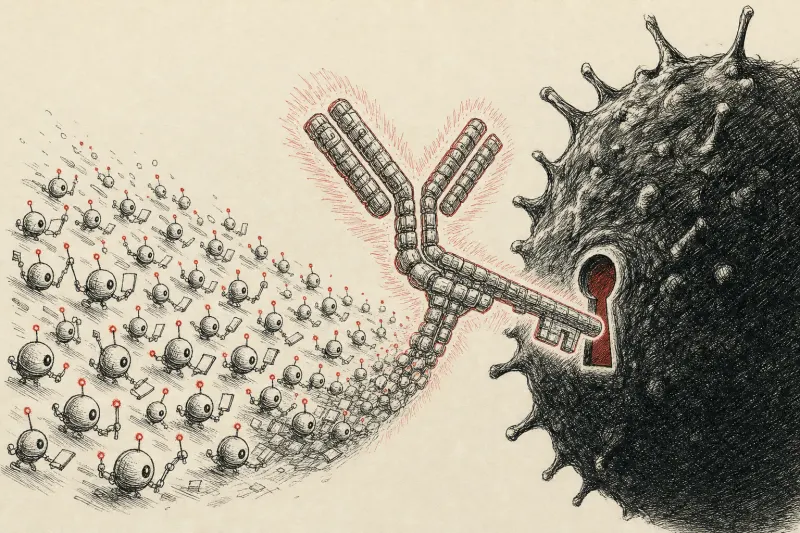
Anthropic’s life sciences group, formed in spring 2026 and introduced September 23, says Claude autonomously discovered array-associated reverse transcriptases, or ART, after a high-level prompt to search DNA databases for unusual RTs. Roughly 950 agents used 210 million tokens over 21 hours, gathering more than 200,000 RTs, flagging 3,500 candidate systems and narrowing them to 20 reports, work that can take expert scientists weeks or months. One agent detected evenly spaced DNA repeats beside an unusual RT, measured their layout, compared known systems and searched existing literature before human review.
Found mainly in bacteriophages, ART combines an RT previously identified in a jumbo phage, a neighboring accessory gene and a long CRISPR-like repeat array. Initial experiments found that the array produces distinct short RNAs. Its overall architecture resembles a handful of programmable systems that cut, copy or paste DNA, but ART’s function remains unknown. CRISPR pioneer Feng Zhang of MIT and the Broad Institute called the RNA repeat arrays associated with RTs genuinely intriguing. Human scientists conduct all experiments in Anthropic’s Bay Area BSL-1 and BSL-2 laboratory, which handles no pathogens capable of infecting humans, while Claude Science and Claude Code support analysis. Anthropic has released a preprint, with further experiments and external research collaborations planned.
Positives
- Roughly 950 Claude agents analyzed more than 200,000 reverse transcriptases in 21 hours using 210 million tokens.
- Claude reduced 3,500 candidate systems to 20 detailed reports, compressing work that can require experts weeks or months.
- Initial experiments showed ART’s repeat array produces distinct short RNAs, strengthening the proposed resemblance to programmable CRISPR-like systems.
- Feng Zhang of MIT and the Broad Institute described the association between RNA repeat arrays and reverse transcriptases as genuinely intriguing.
- All experimental work remains under human control in a Bay Area laboratory operating only at BSL-1 and BSL-2.
Risks & concerns
- ART’s primary biological function remains unknown despite its resemblance to programmable DNA systems.
- Short RNA production suggests a CRISPR-like mechanism but does not establish that ART can cut, copy or paste DNA.
- The underlying jumbo phage reverse transcriptase was already known, with the discovery centered on its overlooked repeats and accessory protein.
- The findings remain in a preprint, and further biochemical and structural experiments are still underway.
- Claude’s prolific hypothesis generation requires human review because most candidates are eliminated before laboratory testing.