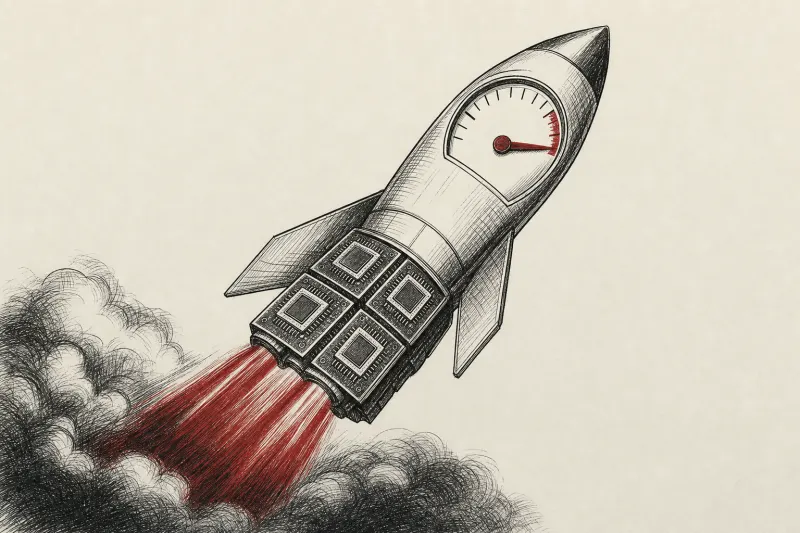
Non-Nvidia AI Chips Lead Blackwell by 14 Points in Enterprise Evaluations
A July 2026 survey finds 39.4% eye non-Nvidia AI chips versus 25.3% for next-gen Nvidia GPUs as cloud, open-source and neocloud use expands.
Summary
In July 2026, 39.4% of 170 AI infrastructure respondents planned to evaluate AWS Trainium, Google TPU, AMD Instinct, Intel Gaudi or in-house ASICs within 12 months, versus 25.3% for Nvidia Blackwell GB300 or other next-generation GPUs, a 14-point gap; alternatives rose from 31.8% in June. Interest reached 57.1% of C-suite respondents, 12 of 21, and 50% of final decision-makers, while Nvidia remained production's default.
Production expanded as zero to three month platform-change plans fell from 38.3% in June to 28.8% in July and roughly 40% planned none. Azure use rose 29% to 47.1%, Gemini 41.1% to 47.6%, OpenAI 40.2% to 49.4% and Anthropic 12.1% to 24.7; July skewed larger, with 57% above 1,000 employees versus 37%. For self-operated GPUs, utilization above 50% rose 13% to 23%. Uptime and reliability priority climbed 42.1% to 51.2%, performance 24.3% to 35.3%, token cost 7.5% to 15.9% and GPU access 18.7% to 23.5%, while total cost of ownership fell 34.6% to 21.8%. Ease improved from 3.84 to 4.04 out of five, satisfaction from 4.07 to 4.14 and value stayed near 3.9.
Architectural control widened: 79.2% of 101 context-layer respondents retained tooling outside one provider, versus about 65.3%, while context-related wrong answers rose from 57.4% to 68.3%. Neocloud expansion intent rose 33% to 38%; CoreWeave, Lambda, Crusoe and Nebius production use increased 1.9% to 5.9%. CoreWeave held about $104 billion in backlog plus over $25 billion in early Q3 commitments; Nebius said its 2027 capacity could sell out after four second-quarter deals averaging over $1 billion. Self-managed PyTorch, Triton, vLLM, Ray and Kubernetes production stacks rose 3.7% to 12.9%. Independent June and July cross-sections had 107 and 170 respondents, no significance testing and different samples, making changes directional rather than causal.
Positives
- 39.4% planned to evaluate non-Nvidia accelerators, up from 31.8% in June and 14 points ahead of next-generation Nvidia GPUs.
- Azure production adoption climbed 18.1 percentage points to 47.1%, while OpenAI reached 49.4%, Gemini 47.6% and Anthropic 24.7%.
- GPU operators exceeding 50% utilization increased from 13% to 23%, indicating more intensive use of existing infrastructure.
- 79.2% of context-layer respondents retained architectural control outside one model provider, up from approximately 65.3%.
- Self-managed open-source production stacks using technologies including PyTorch, Triton, vLLM, Ray and Kubernetes rose from 3.7% to 12.9%.
- CoreWeave's roughly $104 billion backlog and Nebius's four billion-dollar-plus average contracts indicate substantial neocloud demand.
Risks & concerns
- Zero to three month platform-change plans fell from 38.3% to 28.8%, showing greater activity has not accelerated major platform decisions.
- 68.3% of context-layer respondents experienced confident but incorrect agent answers caused by missing or faulty context, up from 57.4%.
- Perceived infrastructure value remained near 3.9 out of five despite broader deployment, higher utilization and easier implementation.
- Neocloud production use reached only 5.9% despite 38% expansion intent, leaving reliability, security, support, networking and data management unproven.
- Self-managed open-source stacks transfer responsibility for upgrades, security, observability, integration and production support to enterprise teams.
- Different respondent mixes and no statistical-significance testing mean June to July changes are directional signals, not evidence of causation.