OlmoEarth Studio Adds Custom Embedding Exports for Geospatial AI
OlmoEarth Studio now exports custom Earth observation embeddings as GeoTIFFs for search, mapping, change detection and analysis using very few labels.
Summary
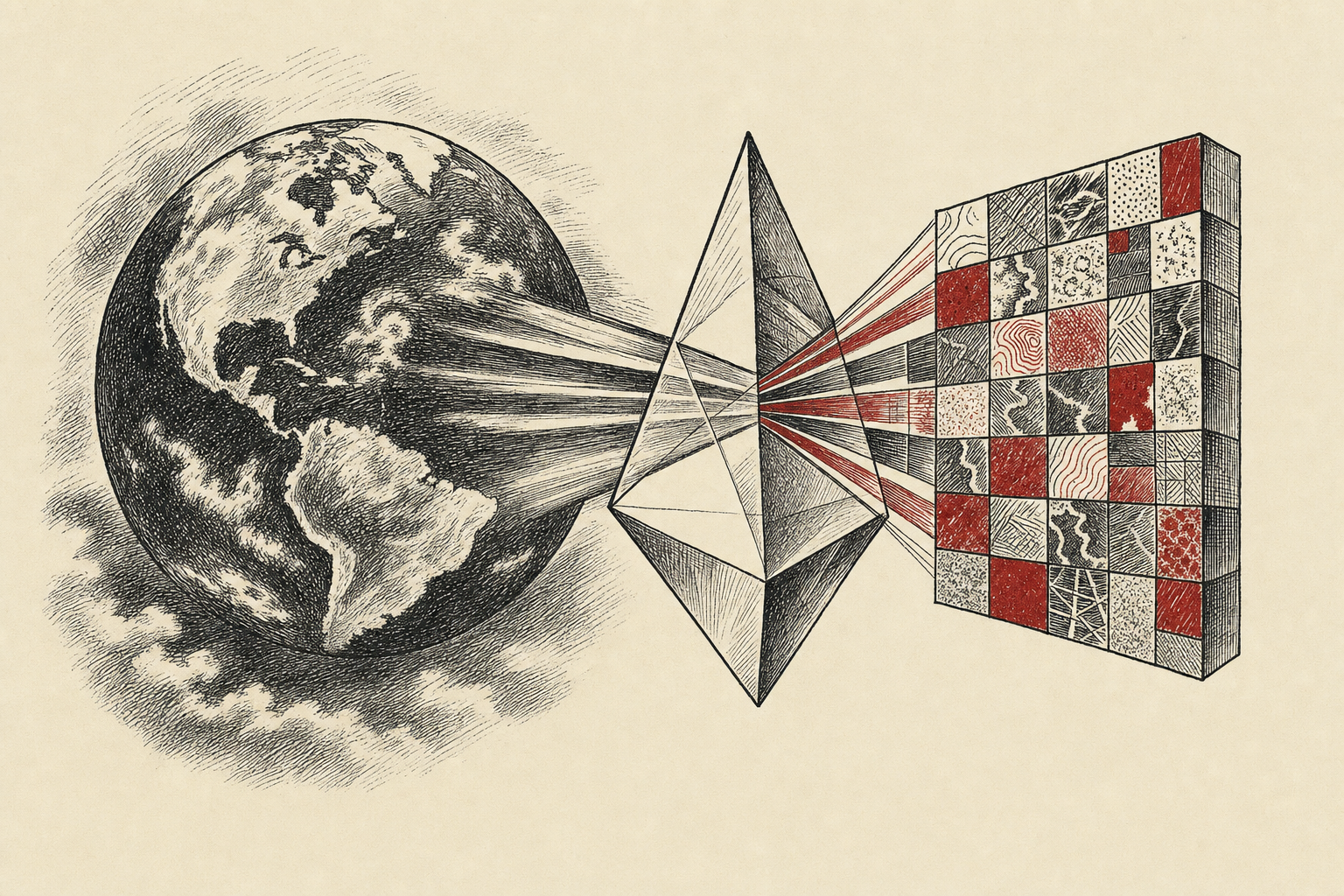
On August 12, 2026, Ai2 announced in a Hugging Face enterprise post that OlmoEarth Studio can compute on demand and export custom Earth observation embeddings from open source OlmoEarth foundation models; code, weights and the paper are public, while Studio access requires contacting Ai2. Users choose a polygon, 1 to 12 monthly periods, Nano with 128 dimensions and 1.4 million parameters, Tiny with 192 and 6.2 million, or Base with 768 and 89 million, 10, 20, 40, or 80 meter pixels, and Sentinel-2 L2A, Sentinel-1 RTC, or both. Each Cloud-Optimized GeoTIFF has one int8 band per dimension, spanning -127 to +127 with -128 for nodata, and can be dequantized.
Frozen embeddings enable cosine similarity search, few-shot segmentation, change detection and PCA exploration. Tests used annual, or monthly for change, OlmoEarth-v1-Tiny at 40 meters with Sentinel-2 composites: near Merced, California, irrigated fields scored at least 0.89 against an agricultural query, while an airport, reservoir and arid rangeland scored around zero. In Ca Mau, Vietnam, logistic regression trained on 60 ESA WorldCover 2021 labels, 20 each for mangrove, water and other, achieved weighted F1 of 0.84; raising labels from 30 to 300 barely helped. Cosine distance between September 2023 and September 2024 exposed the July to September 2024 Park Fire scar in Butte County, while PCA recovered Flevoland parcel, crop, water and urban structure without labels. A global Base visualization clustered seasonal Sentinel-2 embeddings from 1.1 million samples into 15 k-means groups after PCA, using patch size 8.
Exports run with QGIS, GDAL, rasterio or scripts; supervised fine-tuning is available when frozen linear probes are insufficient, although larger encoders increase compute and storage. Results require use-case validation because cloud cover, atmospheric artifacts and missing observations can distort vectors. Sentinel-2 came from the European Space Agency through Microsoft Planetary Computer; mangrove references used ESA WorldCover 2021 v200.
Positives
- 60 labeled pixels produced a Ca Mau land-cover map with weighted F1 of 0.84 using OlmoEarth-v1-Tiny embeddings.
- 0.89 or higher similarity scores identified irrigated agricultural parcels near Merced without labels or additional training.
- September 2023 and September 2024 embeddings revealed the 2024 Park Fire burn scar through per-pixel cosine distance.
- Three encoder sizes, four spatial resolutions and two Sentinel imagery sources let users tailor exports to their workload.
- Cloud-Optimized GeoTIFF exports work with QGIS, GDAL, rasterio and custom scripts.
Risks & concerns
- Persistent cloud cover, atmospheric artifacts and missing observations can degrade the resulting embedding vectors.
- Base has 89 million parameters and 768 dimensions, increasing compute and storage requirements over Nano and Tiny.
- Custom Studio embeddings require access from Ai2, although the public models can be run independently.
- Frozen embeddings may not meet higher performance requirements, making supervised fine-tuning necessary for some applications.