SpaceX Shares Sink 10% as $16 Billion AI Spending Overshadows Earnings Beat
SpaceX beat revenue and loss forecasts in its first earnings report, but shares slid as a $16 billion AI spending surge raised concerns over future costs.
Summary
SpaceX exceeded Wall Street’s financial forecasts in its first earnings report as a publicly traded company, but investors focused instead on the extraordinary cost of Elon Musk’s artificial-intelligence expansion. The company reported on Tuesday, August 4, 2026, that quarterly revenue rose 92 percent year over year to $7.8 billion, compared with analysts’ $6.82 billion estimate. Its net loss was approximately $541 million, substantially narrower than the expected $2.12 billion. Despite those better-than-forecast results, SpaceX shares dropped 10 percent in early trading on Wednesday, August 5.
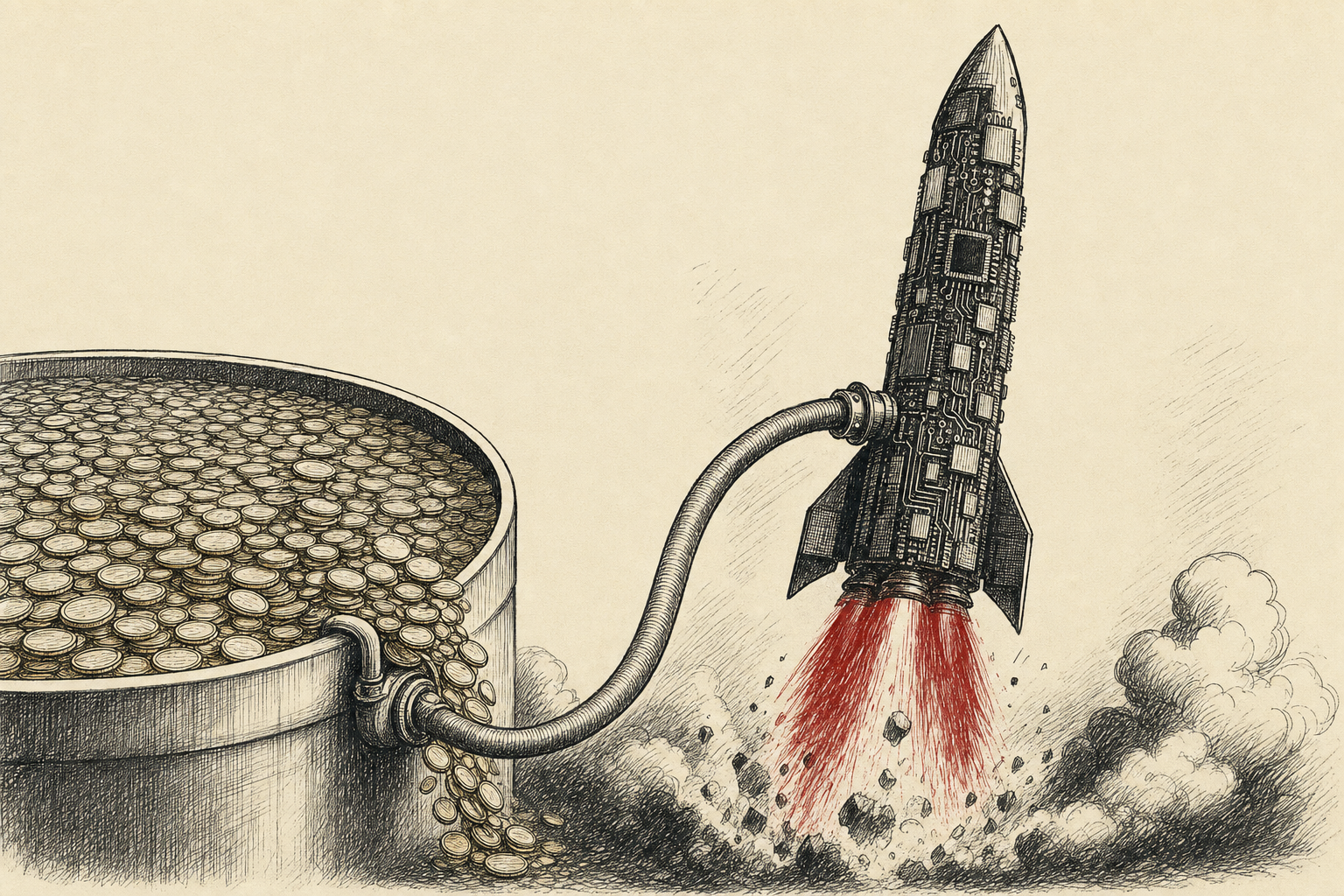
The central concern was almost $16 billion in AI-related capital expenditure, twice the previous quarter’s level and above Wall Street expectations. SpaceX said spending would remain around that level for at least another two quarters. Musk told investors that computing capacity should rise from 2 gigawatts at the end of 2026 to nearer 10GW than 5GW by the end of 2027. Because each additional gigawatt can require tens of billions of dollars, primarily for chips, the plan implies a prolonged need for capital. Musk also said future infrastructure would use Nvidia hardware exclusively. At the upper end of his projection, the data centers’ electricity demand could rival New York City’s peak summer consumption.
The report follows SpaceX’s $86 billion initial public offering in June 2026, which depended heavily on expectations of rapid future growth. Shares climbed to $225 during the week after the listing but had fallen to $112 by Wednesday, leaving them at roughly half their peak. The company nevertheless retains a reported market capitalization of $1.65 trillion, a valuation that reflects expectations extending well beyond its existing rocket and satellite businesses. Those expectations include reusable Mars missions, orbital data centers and a major role in AI infrastructure and development.
There is evidence of fast AI growth, although its quality and durability remain open to interpretation. SpaceX’s AI revenue more than tripled quarter over quarter to $2.56 billion, primarily through leasing data center capacity to companies including Anthropic and Google. Chief financial officer Bret Johnsen projected more than $100 billion in annual recurring revenue by the end of 2026, with cloud services driving most of the increase. However, leasing capacity to other AI developers limits the computing resources available for SpaceX’s own models and may constrain margins if the company functions mainly as a cloud provider. Musk said the latest Grok models are being trained on SpaceX data, which he believes will improve their engineering capabilities.
Several unresolved factors could influence the stock next. Musk said first-generation orbital data centers, called Starmind AI-1, could begin launching in 2027, but execution, cost and commercial demand remain uncertain. Short interest has reached the equivalent of 220 million shares, or about 34 percent of freely traded stock. Deutsche Bank also identified the August 6 expiration of the employee lock-up and weaker-than-expected purchases by passive Nasdaq 100 funds as pressures on the share price. Investors are additionally assessing a possible SpaceX-Tesla merger after Musk confirmed growing collaboration, including the Terafab semiconductor initiative, while saying any combination would require an appropriate formal process.
Positives
- Quarterly revenue reached $7.8 billion, beating the $6.82 billion analyst estimate and increasing 92 percent from a year earlier.
- SpaceX’s net loss of about $541 million was far narrower than the $2.12 billion loss analysts had expected.
- AI revenue more than tripled from the previous quarter to $2.56 billion, supported by capacity-leasing agreements with Anthropic and Google.
- Chief financial officer Bret Johnsen projected that annual recurring revenue would exceed $100 billion by the end of 2026, with cloud services providing most of the anticipated growth.
- Musk said SpaceX expects to begin launching its first Starmind AI-1 orbital data centers in 2027, indicating that the project has moved beyond a purely long-term concept.
Risks & concerns
- SpaceX spent almost $16 billion on AI capital expenditure during the quarter, double the previous quarter and above Wall Street expectations.
- The company expects AI spending to remain near its current level for at least two more quarters, creating continuing pressure on cash requirements and profitability.
- SpaceX shares fell 10 percent in early trading on August 5 and had declined from a post-IPO peak of $225 to $112.
- Leasing most of its data center capacity to outside AI companies could restrict SpaceX’s ability to train its own models and may cap margins if cloud infrastructure remains its main AI business.
- Short interest rose to the equivalent of 220 million shares, representing approximately 34 percent of the stock available for public trading.
- SpaceX’s $1.65 trillion valuation depends partly on uncertain, capital-intensive goals including Mars missions, orbital data centers and large-scale AI development.