Stanford’s 37,000 AI Agents Design Lung Cancer ADC Validated by Merck
Stanford’s 37,000-agent Virtual Biotech designed a lung cancer therapy later validated by Merck and found signals tied to 50% higher market success rates.
Summary
VentureBeat’s August 7, 2026 report from VB Transform 2026 says James Zou, Stanford University associate professor of biomedical data science, expects coordinated swarms to supersede the Claude Code style one engineer, one agent model. His five to eight agent Virtual Lab mirrored his Stanford team through an AI professor, specialist AI students, meetings and an agent school for supervised fine tuning. It designed nanobody proteins that wet lab tests found bound recent COVID variants better than earlier human designs. Stanford then built Virtual Biotech, tens of thousands of specialists overseen by a chief scientific officer agent across target discovery, molecule design, safety and clinical trials, with dedicated genetics, genomics and single cell agents.
In a direct scientific comparison, agent debates produced more creative, robust solutions and resisted compounding errors better than one agent. Orchestration became the bottleneck because MCP wrappers still leave human oriented legacy databases, APIs, PDFs, figures and tables difficult for models and vulnerable to hallucinations. Stanford’s Paperclip digitizes unstructured data into an AI native virtual file system, giving agents code and file access to millions of papers. Zou reported higher accuracy and reductions exceeding one order of magnitude in time and cost.
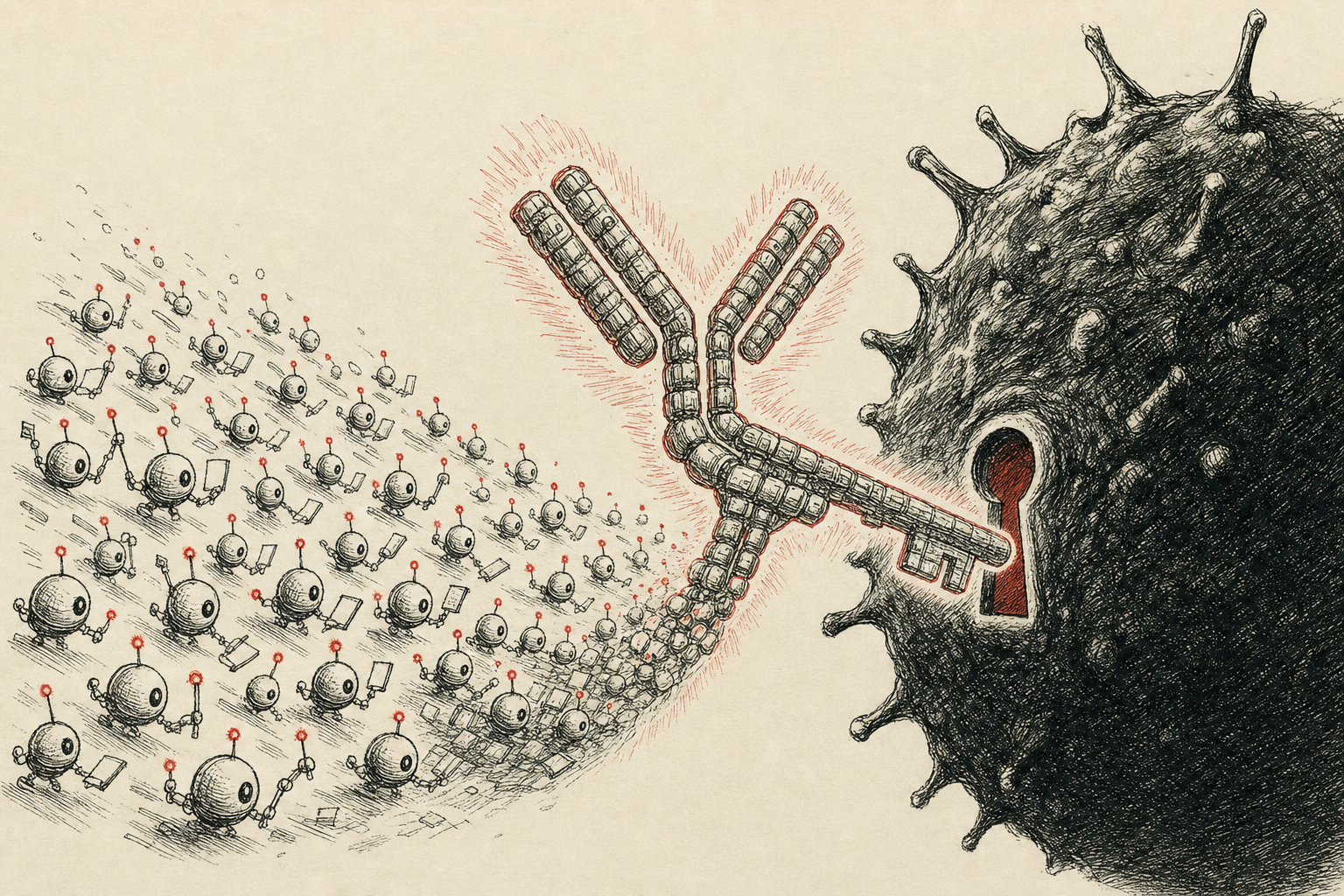
Virtual Biotech deployed 37,000 clinical trial agents to synthesize fragmented data, identifying single cell features whose supported drug targets were about 50% more likely to reach market than comparable drugs without them. Using only data published before January 2025, the agents autonomously designed an antibody drug conjugate targeting CD276 in lung cancer. Zou said Merck independently developed and validated the same design several months later, after which it received FDA breakthrough designation. He advocates replacing rigid workflows with open environments providing infrastructure, incentives and guardrails, optimizing collaboration rather than individual models, although reinforcement learning and supervised fine tuning remain options for single agents.
Positives
- Five to eight Virtual Lab agents designed nanobodies that bound recent COVID variants better than previous human designed proteins in wet lab tests.
- 37,000 clinical trial agents identified single cell features linked to about 50% better odds of supported drug targets reaching market.
- Merck independently developed and validated the CD276 lung cancer design several months after Stanford’s agents produced it from pre January 2025 data.
- FDA breakthrough designation provided further external support for the antibody drug conjugate design, according to Zou’s account.
- Paperclip improved accuracy while cutting agent time and cost by more than one order of magnitude, Zou reported.
- Multi agent debates produced more creative, robust scientific solutions and better resistance to compounding errors than a single agent in Stanford’s comparison.
Risks & concerns
- Tens of thousands of agents make orchestration, rather than model capability alone, the primary scaling bottleneck.
- MCP wrappers do not make legacy databases and APIs sufficiently usable by agents because those systems were designed for humans or earlier algorithms.
- PDFs, complex figures and tables remain inefficient inputs for standard text models and can trigger hallucinations.
- Stanford must optimize collaboration parameters, infrastructure, incentives and guardrails as agent swarms grow, complicating management beyond individual model tuning.
- The source gives no exact Paperclip accuracy, time or cost measurements beyond Zou’s claim of an improvement exceeding one order of magnitude.